
Daryl Pullman proposes that it is time for more privately funded health care in Canada, as long as privately financed care is publicly administered.
__________________________________________
The Alberta government’s Bill 11 (Health Statues Amendment Act, 2025) introduced late last year but which just came into effect, moves that province a step closer to American style privatized healthcare. Under Bill 11, eligible physicians in Alberta will be able to provide publicly funded care through the provincial health system while also offering certain privately paid services. Private patients can choose to pay out of pocket rather than waiting for care in the public system. Bill 11 effectively creates a two-tiered system in which those who can afford it can skip the queue to gain quicker access to some specified services.
Bill 11 is only the latest in a continuing series of steps toward privatization that have emerged across the country over the past 25 years. Numerous provinces now permit private radiology services. Private clinics like the Shouldice Hernia Hospital in Ontario, and the Cambie Surgery Centre in British Columbia have been operating for decades. Although Dr. Brian Day, the founder of the Cambie clinic failed in his attempt to have the Supreme Court of Canada (SCC) declare B.C.’s Medicare Protection Act’s prohibition against privatization unconstitutional, the SCC’s refusal to consider his petition has had no practical consequences. Dr. Day’s clinic continues to operate as it has for almost three decades. Indeed, according to Dr. Day, the B.C. government’s own worker’s compensation program is one of his clinic’s most frequent clients.
The fact of the matter is that Canada already has an informal two-tiered healthcare system. In addition to the private clinics mentioned here, tens of thousands of Canadians travel abroad each year to purchase quicker access to healthcare services. Annually, literally millions of Canadian healthcare dollars go into the pockets of private investors in Canada and abroad.
In an effort to curtail this move toward privatization of the Canadian healthcare system, and to recapture those healthcare dollars now flowing into the pockets of private investors, I propose that the Canadian provinces should move toward a two-tiered publicly administered healthcare system. Rather than allowing the continuing expansion of private clinics and related privately provided healthcare services, the provinces should create their own publicly administered healthcare tier that is available to those willing and able to pay. Services offered in this tier would be priced at a premium (as they are currently in the private clinics springing up across the country). Rather than turning over these “profits” to private investors, the excess funds collected in this tier would be funneled back into the public system to the benefit of everyone. Indeed, a full implementation of this proposal would eliminate private radiology and surgical clinics across the board, bringing all such services under public purview.
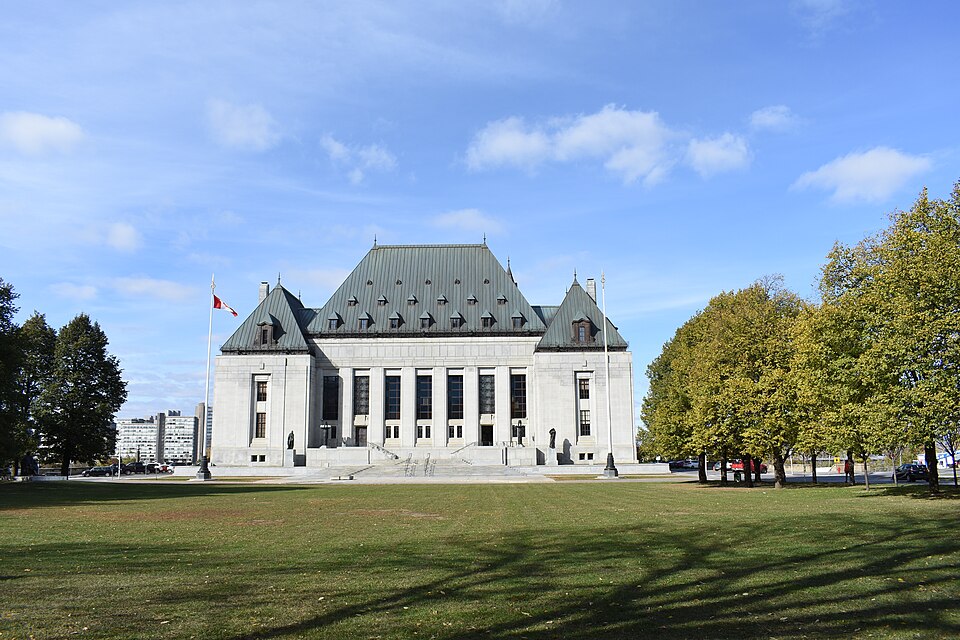
Photo Credit: Jon Kolbert/Wikimedia Commons. Image Description: A photo of the Supreme Court of Canada building in Ottawa.
Under this proposal, for example, one of the surgeries in a local hospital might be reserved specifically for those willing and able to pay. The physicians working in that surgery would be paid as they would normally under the province’s billing system; there would be no incentive or opportunity to work in a private system as this simply wouldn’t be available. However, the cost of the surgery itself would be covered not by the provincial government but through the premium fees charged to patients. The cost of joint replacement surgery at the Cambie clinic in B.C. ranges from $22,000.00 to $40,000.00. A similar fee could be charged in the publicly administered two-tiered system, with the “profits” being used to enhance the overall healthcare system to the benefit of everyone.
This proposal is understandably controversial as it would formally admit that those who can afford it will get quicker access to certain healthcare services. But this is only acknowledging a reality that already exists. In fact, when one considers the broader social determinants of health like housing, education, community context and so forth, those who can afford to pay generally get better access to all of these things. While it is important that a publicly funded healthcare system provides basic services to everyone despite one’s ability to pay, allowing quicker access to some specific services does not undermine that basic tenet. A two-tiered publicly administered healthcare system would be better equipped to redistribute the benefits and burdens of the healthcare system towards the public good.
In addition to eliminating the incentive for physicians and other healthcare professionals to choose between working in the private or the public system, public administration of the two-tiered system would remove the problem of private clinics cherry-picking only the least complicated patients while unloading any post-operative complications onto the public system. All patients, regardless of tier, would be patients in the public system. The only difference would be that some patients would be paying for their care out-of-pocket.
Two-tiered healthcare is already the reality in Canada. The proposed public administration of that reality is an attempt to limit the treatment of healthcare in Canada as a market commodity while enhancing its profile as a public good.
_________________________________________
Daryl Pullman is University Research Professor of Bioethics in the Memorial University Centre for Bioethics.


 Impact Ethics