
Sarojini Nadimpally relates some lessons from her experiences of living with cancer.
__________________________________________
I have spent three decades advocating in public health, sitting across from policymakers defending the rights of people who could not be in the room. In this work, confrontation has not been a failure of civility but a necessity.
That understanding took on a new dimension last May, when I was diagnosed with breast cancer. What followed, including chemotherapy, surgery, radiation, and eighteen cycles of infusions for my biomarker, has been the most demanding experience of my life: physically, financially and emotionally. It changed my relationship with myself, my work, and illness. It forced me to confront a question I had never really considered: how do you inhabit a body that feels altered and unfamiliar?
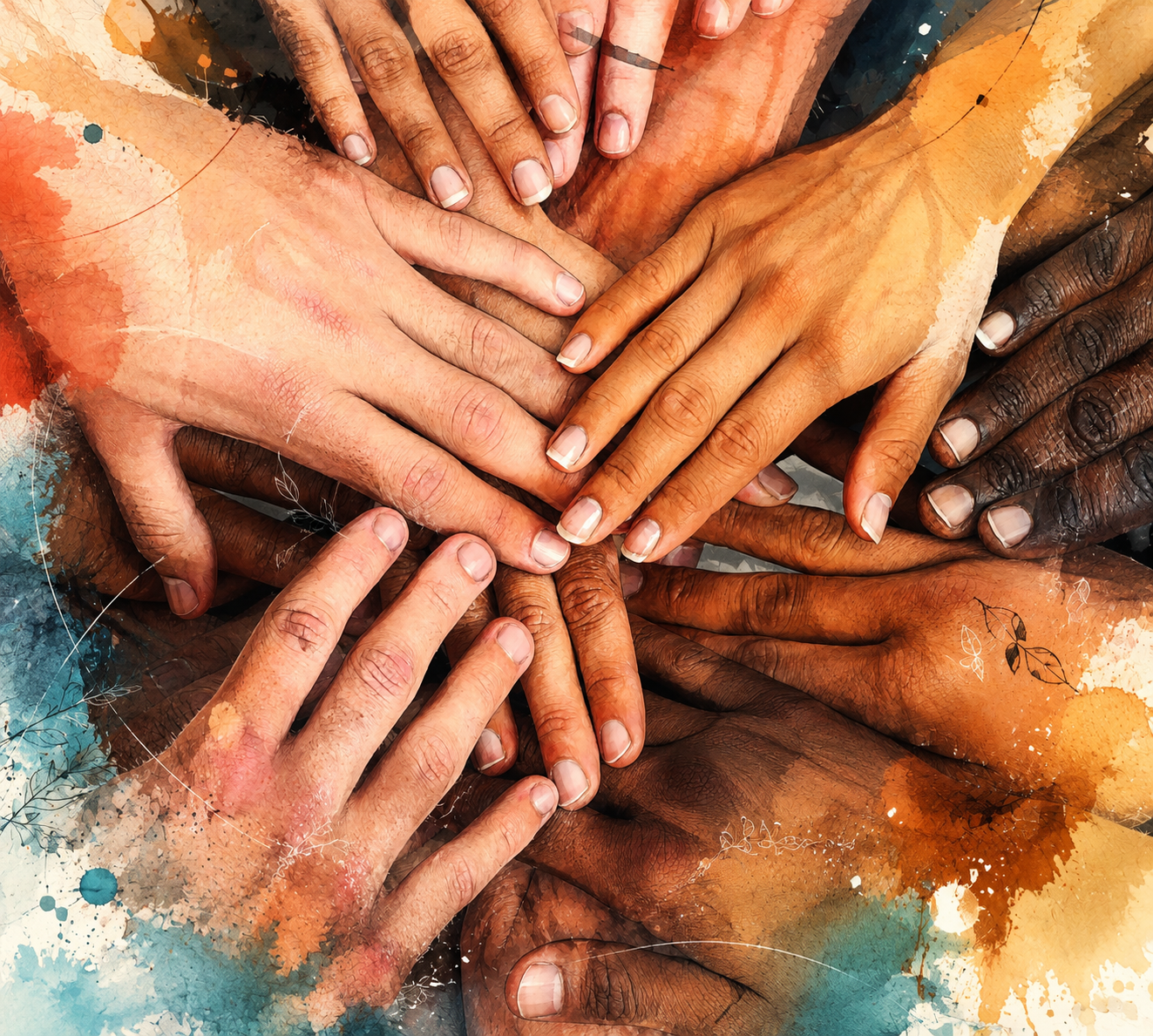
Image Description: An AI generated image of many hands joined together.
For most of my adult life, I have known myself through action: organizing, resisting, pushing back, and refusing to accept injustice as inevitable. Advocacy taught me to see structures of exploitation and inequity and to challenge them. When I was diagnosed, my first instinct was adversarial. My first understanding of cancer was shaped by the language of battle. The tumour was an enemy, the rogue cells invaders, and cancer care reinforced this framing. We constantly speak of fighting cancer, battling disease, and winning or losing. And when you are told you are a warrior, it gives you a place to stand; it organizes fear into forward motion. I needed that.
But this metaphor has a cost. It asks you to think of your own body as enemy territory, treating the cells that turned, the tissue removed, and the body altered by chemicals as foreign. That framing might get you through the early weeks, but it can prevent you from coming home to yourself. The pressure to keep fighting, stay positive, and perform courageously extends beyond healing. It asks patients to present their suffering in ways that are comfortable for others. That recognition felt familiar: it is what women are routinely asked to do, bearing difficulty quietly as strength. I noticed this in waiting rooms and consultations, the way appointments were structured around what would be done next, not what was experienced. Uncertainty and anxiety filled every chair and were rarely addressed. Illness also revealed how deeply medicine is constructed around action and cure, leaving less room for distress or altered ways of living. As a patient, I found myself asking not only what treatment could do to the body, but also what kinds of experiences and emotions healthcare systems are willing to recognize as part of healing.
Before I could think about the politics of illness, I had to reckon with the body itself. My body would not consent to the neat separation that martial jargon demanded. The tumour was not separate from me. The malignant cells and the tissue that had been removed were part of me. The chemicals used to treat me caused their own damage even as they healed. There was no front line. In a profound sense, the tumor formed part of who I was.
The body I had lived in for six decades felt strange under treatment. Mucositis made eating painful. Fatigue and metabolic changes drained energy, while neuropathy made movement unstable. The rhythms of everyday life were disrupted. I had watched women go through these experiences in the communities I work with. I had accompanied them to hospitals, through difficult moments and hard conversations. I had not fully understood it until it was mine.
What I had not understood was the loneliness of inhabiting a body under siege by both disease and treatment, or the moral pressure placed on patients to remain brave, optimistic, and combative. Fear of recurrence, death, or dependence is treated almost as a failure of courage. But that is not a weakness. It is an honest response to what cannot be known. Accepting uncertainty became as important as managing the disease itself. Survival could not rest solely on confrontation. There had to be acceptance, not of injustice or suffering, but of reality itself. I could rage against the disease, and sometimes I did. But I also had to live with a body undergoing change: exhausted from treatment, transformed in ways that could not be reversed. Sometimes the body cannot be conquered; it can only be listened to.
Surrender is not the same as recognition. One abandons the self; the other allows it to remain intact despite profound change. Reconciliation is neither a cure for grief nor its end. The body after cancer treatment may not be the same as before. The concern about recurrence does not resolve with the end of treatment.
Illness changed not my commitment to confrontation, but the place from which I confront it. It is no longer only political; it is also deeply personal. But reconciliation is not the opposite of confrontation. It is what makes confrontation sustainable: grounded in vulnerability, recognition, and honest attention to what the body, and the person living in it, actually need.
__________________________________________
Sarojini Nadimpally is a public health researcher who works on gender, health, ethics, reproductive and biotechnologies.


