
Lynette Reid describes the work done at Dalhousie to diversify the case-based learning (CBL) curriculum in the medical program.
__________________________________________
Representation of racialized communities in Dalhousie’s case diversification project involved more than just evidence review in light of the scientific reassessment of biological racist beliefs (although that was a central aspect of our process).
There are many aspects to portraying racialized identities in a medical curriculum. One is interpersonal racism: how to identify it and how to address it in educational and clinical environments. Another is portraying locally relevant intersectionalities and the lived experience of communities. Community engagement is important. The context of our work included the participation of our program’s first Academic Lead for Black Health (Dr. Leah Jones), whose background in Cape Breton’s African Nova Scotian (ANS) community and clinical leadership with community health initiatives gave us the opportunity to discuss the cases with such a community.
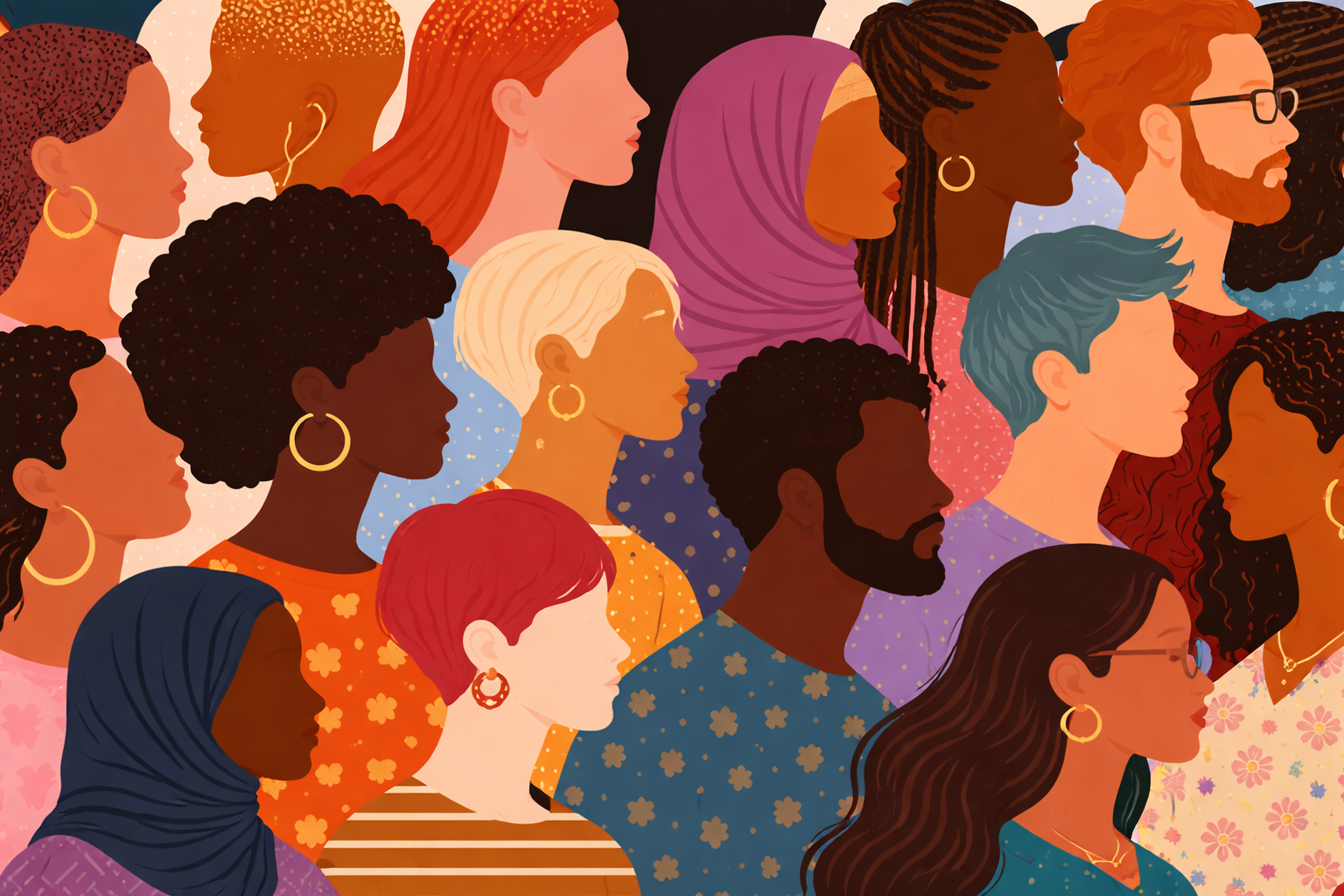
Image Description: An AI generated photo of diverse people representing different races and genders.
Sarah Peddle, manager of our service learning program, was hugely important in educating me on a model of community engagement that focuses on partnership and understands the place of this one small piece of the puzzle (curriculum) in terms of the broader relationship of the medical school to the community. When we met with people from the ANS community health initiatives and discussed drafts of some cases, the pointed question arose: did we think that bringing cases to them was enough? In response, I said I would have been embarrassed to ask them for input into the curriculum, if the program wasn’t already taking action on a Black learners admissions pathway and academic leadership for improving clinical services. This was a lesson I’d learned a decade earlier when Indigenous health fit within the scope of a curriculum unit that I’d co-designed. It’s not right for a colonial institution to ask for curriculum input from a community, when the institution has shown no commitment to developing a physician work force and cadre of faculty that includes them (the landscape of Indigenous health has changed since then in our institution as well).
A common problem in diversifying patient identities (across all dimensions of identity) is managing the question of representation and bias. In this post I’ll give some examples of how we went with or against the biases that result from presenting case-based learning (CBL) patients as belonging to the group in which a condition most commonly appears.
Fifteen years earlier, I’d contributed to a new sickle cell case in the medical curriculum. This was in part in response to a local Black community concern that our physicians were ignoring conditions prevalent in the Black community (I personally heard this concern expressed by someone who was active in but not a descendent of the traditional ANS community, hence the language choices in this statement). The geneticists had responded to my idea by arguing that the ANS population, despite being descendants of people held in slavery in the US, don’t carry the sickle cell allele. It would have been clinically apparent in absence of screening if they did. We reflected this insight in the patient identity of that case at the time: they were Black, but not African Nova Scotian. On our review, though, the Case Diversification Working Group found the case to be laden with language pathologizing Blackness. It wasn’t what the original case writing group intended, of course, but if you put stigmatizing language for genetics (“faults,” “flaws,” “mutations”) together with Black identity, that’s what you create.
This was another learning opportunity for me. The group didn’t notice my name was on the “case authors” list, and I didn’t “out myself” in the discussion, partly I’m sure out of embarrassment but also so as not to inhibit their critique or center my own white guilt. This time the patient is of Greek descent, and we included some discussion of the environments that led to the genetic adaptation protective of malaria. We didn’t leave out the information that sickle cell is an important health concern for African Americans. Throughout, we distinguished African Americans from Black Canadians and African Nova Scotians, alerting students and clinical faculty that generalizing from US data to Canada or using the US term for Black people in Canada is not appropriate.
With Cystic Fibrosis, we portrayed a patient of Southeast Asian origin instead of Northern European, giving learners the opportunity to discuss gaps in genetic testing for alleles associated with CF in non-European populations. We updated the information that Multiple Sclerosis is a disease of Northern European populations. For over 10 years it has been established that it’s at least equally prevalent in Black women. One member of our group had a patient who had been on a long journey of misdiagnosis because her physicians hadn’t considered MS in a Black woman.
Sometimes we left intact the epidemiologically more common connection between identity and condition, challenging oppression in the case in other ways. The subject in our TB case remained a newcomer from China. However, this was no longer the only patient in the CBL curriculum from China. We also updated the case to communicate, to the surprise of many, that TB is not found in Mikma’q communities, reflecting the importance of not generalizing across hundreds of First Nations. The subtle nature of medical racism in this case was interesting. I was aware from previous curriculum collaborations that for at least some tutors the TB case was an opportunity to discuss fraud on immigration medical exams (whether or not the case authors intended this). This usage of the case wasn’t stated explicitly anywhere, but it was possible given the case narrative. We revised case details to close the door on the immigration-fraud interpretation. This last example leaves me wondering how many other nuggets of subtle racism I didn’t happen to know about or identify in the review.
Overall, we radically undercut the practice of naming a patient’s racialized identities only where it is “medically relevant.” We stated everyone’s racialized identities. Our scope was CBL cases, and we were not successful in advocating for the same approach on medical exams. Those responsible for student assessments weren’t prepared to move ahead of policies for the national qualifying exams.
Medicine has a long road ahead in dealing with practices of racial stereotyping. Our project took a few steps in one corner of the curriculum, and at a time when enormous change is happening in many areas, but the profession, researchers, and regulators still need to come to a unified approach that they apply consistently.
__________________________________________
Lynette Reid is an associate professor in the Department of Bioethics at Dalhousie University.


 Impact Ethics