
Andria Bianchi and Janet A. Vogt introduce their new book which investigates ethical issues in the lives of people with intellectual and developmental disabilities and autistic people in health care and in other social contexts.
__________________________________________
Bioethics is an interdisciplinary field with a wide range of topics. There are certain perennial issues explored in bioethics, such as complexities associated with consent, capacity, and healthcare decision making. There are also “hot topics” that may gain significant, though potentially temporary, attention as motivated by factors such as legislative changes, media attention, or novel approaches to care. Some current hot topics in bioethics arguably include medical assistance in dying and artificial intelligence.
As bioethics professionals, we believe that these perennial and novel topics deserve attention, and we valued learning about them as part of our bioethics training. However, as individuals who work in and are committed to the developmental services sector for people with disabilities, we were disheartened while completing our degrees in ethics, as well as in our ethics work, by the paucity of dialogue on ethical issues arising from the treatment of neurodiverse populations.
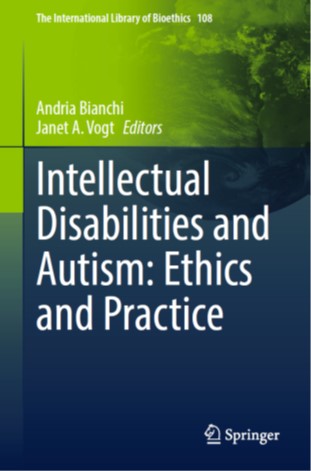
Image Description: An image of the cover page of the book Intellectual Disabilities and Autism: Ethics and Practice.
Our commitment to serving people with intellectual and developmental disabilities and those on the autism spectrum – and the lack of focus that these populations received in our bioethics training– motivated us to co-edit a recently published book entitled Intellectual Disabilities and Autism: Ethics and Practice. The book is comprised of 31 chapters written by scholars and practitioners from different disciplinary backgrounds, each of whom focus on a topic of ethical significance related to those who are neurodiverse. Some chapters offer practical suggestions in response to ethical issues, whereas others offer theoretical arguments in response to ethically complex questions. What holds the book together is its overarching response to ableist stereotypes and societal norms that influence people with intellectual and developmental disabilities and those on the autism spectrum. Every chapter in the book encourages readers to question assumptions about these population and to consider novel ways of thinking about and approaching relevant ethical issues.
As noted in the book’s introduction, “[a]bleism assumes the existence of a perfect kind of human self and body to which ‘disabled’ people are compared unfavorably.” Ableism is prevalent in our society, making it such that people with disabilities of all kinds experience discrimination and are treated in accordance with inaccurate stereotypes. For instance, the idea that a person with an intellectual or developmental disability cannot parent or engage in a consensual romantic relationship, and that autistic people cannot participate in autism research in a meaningful way, are grounded in ableist stereotypes. Such stereotypes and societal norms create barriers to social inclusion for people with intellectual and developmental disabilities and many autistic people. Relatedly, ableism influences the care and treatment received by those who are neurodiverse in health care settings (and beyond). By engaging with ethically complex questions related to these populations in our book, we hope that bioethicists, ethics students, social justice scholars, and others working with people with intellectual and developmental disabilities and autistic people will be better equipped to recognize and respond to relevant consequences of ableism in their everyday lives and work.
The book is organized into six key areas of ethical tension that have practical implications: moral status; capacity and consent; inclusion and empowerment; sexuality, intimacy, romance, and parenting; health care; and ethical responses to “behaviours”. Each section highlights relevant stereotypes and injustices that exist, as experienced by people with intellectual and developmental disabilities or autistic people, and offers a response.
For instance, chapters in the first section highlight and argue against the ways that people with intellectual and developmental disabilities may not be considered moral agents based on ableist stereotypes and assumptions.
Section 2 explores ethical issues related to consent and capacity for different types of decisions (e.g., health care, research); each chapter responds to stereotypes which wrongly assume that people with intellectual and developmental disabilities are incapable of consenting to various decisions that influence their life.
Sections 3 and 4 explore different parts of our society (law, research, health care, politics) wherein people with intellectual and developmental disabilities or autistic people fail to be included in meaningful ways due to ableist traditions.
Section 5 introduces ethical complexities associated with sexuality, relationships, and parenting, where several prevalent and ableist stereotypes are resisted in each chapter (such as the idea that people with intellectual and developmental disabilities cannot and should not parent). The subsequent section acknowledges gaps that exist in our health care system, recognizing that our system is “not built with nor for autistic people or people with IDD [intellectual and developmental disabilities], making it such that those who are neurodiverse can easily fall through the cracks.”
The final section talks about ethical responses to “behaviours” that may be perceived as difficult, where readers are encouraged to unpack assumptions about what is “difficult”, as well as the ethical defensibility of typical responses.
As a first-of-its-kind volume, we hope that Intellectual Disabilities and Autism: Ethics and Practice empowers readers to think differently about and respond differently to ethical issues related to those who are neurodiverse. As demonstrated in each chapter, ethical issues related to people with intellectual disabilities and those on the autism spectrum are significant in number and complexity. Dedicating increased attention to these matters as part of bioethics scholarship, training, and practice is deserved.
__________________________________________
Andria Bianchi is a Clinical Ethicist at the Centre for Clinical Ethics, Unity Health Toronto, an Assistant Professor (status-only) at the Dalla Lana School of Public Health, University of Toronto, and an Affiliate Scientist at the KITE Research Institute.
Janet A. Vogt is a Senior Research Associate and Manager at Surrey Place and a board member of the Community Ethics Network, Toronto.


 Impact Ethics