
Daniel Lucas draws attention to ethical implications of climate change for reproduction.
__________________________________________
As it sometimes happens, real-life occurrences make a point for you. Preparing a talk for a conference, I received an email from the organizers informing me about flooding. “Everything is alright in Passau,” they said, “but there will still be delays if you travel through Austria.” Heavy rains and flooding already interfere with our professional and private lives, and climate science tells us that there will be a lot more in the future.
Having seen flooding and droughts in Europe over the past few years, climate change has finally reached those most responsible for it. And still, we are lucky. We are well aware that while the effects of climate change will influence us more and more in the future, we – and here I speak as a European – are comparatively safe. Not only are other parts of the world more vulnerable to extreme weather phenomena, but they also lack the structures to mitigate the consequences of those events.
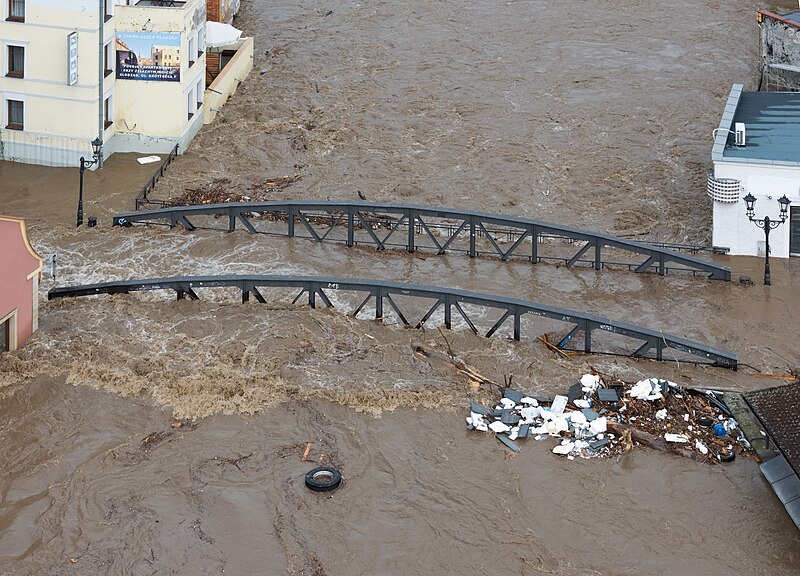
Photo Credit: Wikimedia Commons. Image Description: Iron Bridge in Kłodzko, Poland, during a flood in September 2024.
Another truth is that some parts of the world are far more responsible than others. Historically, it was mainly Europe and North America; while China and India have recently joined the club of those that consume more resources than the sustainable amount. On the other side, the bearers of consequences are those societies and people that live sustainably. The fact that some suffer from the deeds of others, historically and currently, is widely accepted as an injustice. But a solution is not in sight.
Bringing new people into existence is slowly becoming part of the discussion. While antinatalism – the philosophical position that it is morally wrong to bring new people into existence – has been around for a long time, eco-antinatalism has only slowly become part of the discussion. Eco-antinatalists believe that we have to stop, or at least limit, our reproductive endeavours for ecological reasons. The Birth Strike Movement may be among the most vocal movements in this regard.
Some people, like Corey MacIvor, believe this is a matter of fairness. In his approach, which he calls procreative consumption, he argues that reproduction is a fundamentally material practice and, therefore, not solely private. His argument, put very shortly, is that each and every one of us has a just amount of resources we may use. And procreation means using an unjust amount of these resources, at least if you live in a high-emitting society like those in Europe and North America. Hence, it is unjust towards existing people if people in those societies bring more people into existence.
Another matter is the lives of those future people. As pointed out in the beginning, although members of high-emitting societies are not the primary victims of the consequences of climate change, future generations in those societies will suffer from the effects more and more. If one believes that living somewhat harmoniously with non-human animals and having access to essential natural goods, in general, is part of a good human life – and especially a good human childhood – one should ask oneself if it can be justified to bring somebody into a world where those things are less and less secured.
Another, more hands-on, topic is the question of the politics of climate change. While it is often argued that we need to form an understanding of flight and refuge to handle climate change-forced migration, actual politics are going in the opposite direction. Not only has the US seen one of its worst anti-immigrant political campaigns, but also Europe is closing its borders while more and more autocratic and fascist parties gain power. High-emitting countries appear unwilling to make structural changes to their emissions but rather choose to forcefully keep out those who need to migrate. In that case, one may find a good reason not to bring new humans into those societies, not wanting to support these kinds of politics.
Antinatalism and even limiting natality are often called radical answers to the pressing questions of climate change and climate justice. One might at least wonder if they are so radical after all. If one believes that people are at least somewhat responsible for their emissions, limiting or abolishing procreation in high-emitting societies is by far the easiest and most effective way to reduce emissions. One should at least give it a thought.
________________________________________
Daniel Lucas is a PhD candidate at the Professorship for Practical Philosophy, ETH Zürich. Bluesky: @daluc.bsky.social; Twitter: @luc_phil_ger; Mastodon: @lucphil@universeodon.com


 Impact Ethics