
Andrew Fenton examines the New York Declaration on Animal Consciousness with an eye to a previous declaration and some current animal law and policies concerning scientific animal use.
__________________________________________
On April 19th, 2024, the New York Declaration on Animal Consciousness was launched online during a conference on the philosophy of animal minds. Initially signed by 40 scientists and philosophers, it affirms that the current state of the relevant sciences supports a scale of likelihood that many other animals are conscious. While, implicitly, there is a lack of doubt about the sentience of humans, it states that “there is strong scientific support for attributions of conscious experiences to other mammals and birds,” and “at least a realistic possibility of conscious experience in all vertebrates…and many invertebrates.” A final statement advocates considering “welfare risks” when acting towards animals with even a realistic possibility of conscious experience.
The NY Declaration is very much in the tradition of, and something of an update to, the Cambridge Declaration on Consciousness in 2012, though it reads as more tentative than the 2012 Declaration. Nevertheless, the initial signatories are a who’s who in the animal sciences and philosophy of animal minds and so this is no small deal.
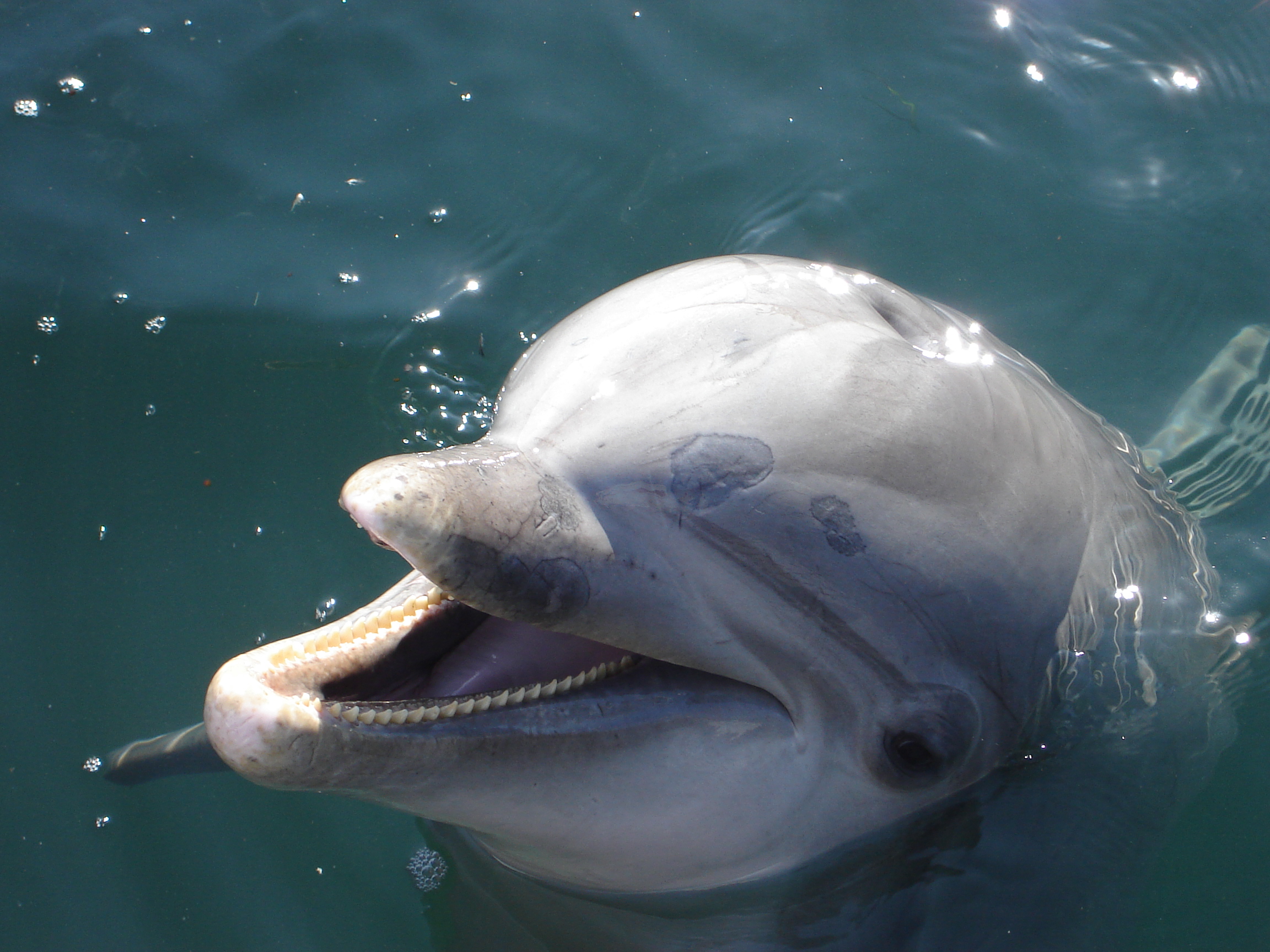
Photo Credit: Ste Elmore/flickr. Image Description: A dolphin.
Though I am now a signatory of the declaration, three things jump out at me. It’s currently de rigueur to accept a “Great Chain of Being” with humans ranked at the top (at least for “Earth-bound” creatures) of a hierarchical cosmic scale of life with animals and other organisms spread out below. The NY Declaration seems to carry on an echo of that outlook, albeit as an epistemological scale of confidence concerning consciousness. This shouldn’t be all that surprising given the historically dominant anthropocentricism of both “Western” philosophy, the mind and behavioral sciences, and “the problem of other minds” (again, in “Western” philosophy). The problem of other minds standardly asserts the certitude of your own mind’s existence and then a qualified confidence about the rest of those commonly regarded as minded, as if one works out what one knows about the universe from the inside out. Here’s the way that should be stated: The problem of other minds standardly asserts the certitude of my mind’s existence – (it’s a first-person framing and, well, that means the existence of my mind is more certain than yours) – and then a qualified confidence about the rest of you (and other animals), as if I work out what I know about the universe from the inside out.
It doesn’t really matter if you accept the assumptions that make such a view plausible. But such a view shouldn’t favour species (or larger taxonomic groupings). When you or I think about how our brains contain the supporting structures that make minds possible, we should also recognize that there’s enough neurological variability within and across species that confidence about other minds should not tidily divide up the universe in a way that reflects a Great Chain of Being.
The second thing that jumps out to me is that even the Cambridge Declaration seemed a little behind the curve. By 2012, academic scientists in many legal jurisdictions around the world worked in countries where animal cruelty was illegal. What’s more, as the 3Rs of Replacement, Reduction, and Refinement governed the use of animals in many academic settings by 2012, the standards of good practice in their work places already (putatively) required them to take the welfare of their animal experimental subjects seriously. The originators of the 3Rs, William Russell and Rex Burch, said this in 1959, “We shall not waste any time on those philosophers who would forbid us to speak of consciousness in non-human animals. This confusion arises from a number of pathological factors….Beliefs of this kind, like solipsism (the fantasy that nobody is conscious except the solipsist himself) and Berkleian idealism (the fantasy that nothing exists when not in the sensory presence of the Berkleian himself) are all entirely pathological” (Russell and Burch 1959, p.15). For Russell and Burch, the 3Rs assumed vertebrate animal consciousness (though they recognized that a case could be made for animals like the octopus).
What about the third thing that jumps out at me? Consider the final statement that we should consider the welfare risks to other animals when making decisions that affect them. Of course, that’s good (albeit vague) ethics, but it’s also something that readily follows from any ethical rationale offered as a justification of the 3Rs. For Russell and Burch, if animals must be used (the first “R”, “Replacement”), and we’re not using more animals than we need (the second “R”, “Reduction”), then all efforts should be made to at least ensure that the animals do not experience unnecessary suffering or distress (though Russell and Burch also expected scientists to promote positive conscious states). I hope the reader is now wondering with me why the academic scientists signing onto the NY Declaration waited so long, why so many others might still be hesitant, and how this has affected their understanding of scientific animal use, the 3Rs, and anti-cruelty legislation.
__________________________________________
Andrew Fenton is an Associate Professor of Philosophy at Dalhousie University


 Impact Ethics